By Autumn Mozeliak
It’s July which means we’re celebrating French American Heritage month! In celebration we’re taking a look at four seldom seen dialects of French that have made a home here in the States!

Acadian French
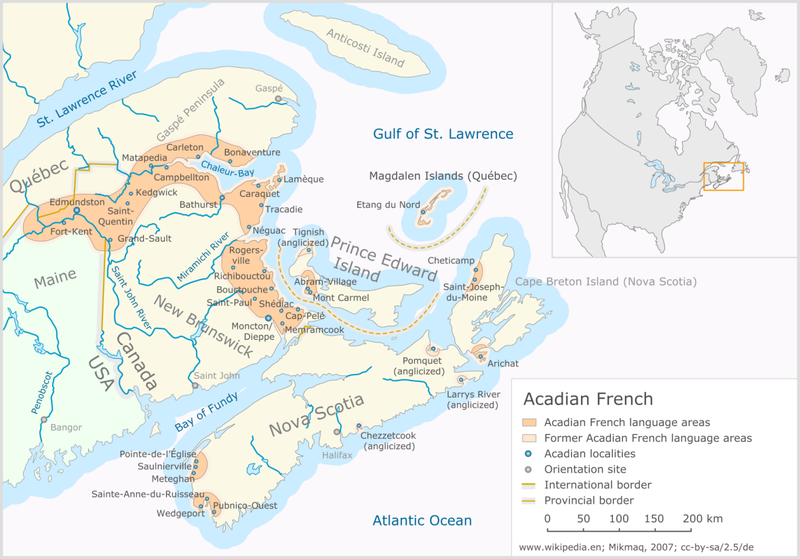
Acadian French, geographically sandwiched between New England French and Québécois, can be found in the Canadian province of New Brunswick and Aroostook County, Maine. Though once upon a time it was much more wide spread and we can find this in the trace amounts of speakers scattered throughout some Canadian territories such as Gaspé Peninsula, Prince Edward Island and the Magdalen Islands of Quebec. With relatively low contact with standard French in the 18th and 19th centuries, Acadian French was able to flourish in its own unique way. Because of this, standard French and Québécois French speakers have a tough time understanding them! So what is actually close to Acadian French? In the mid 1700s, during the French and Indian war, thousands of Acadians fell victim to the Déportation des Acadiens, or the Great Deportation of Acadians. During this period, thousands died or were exiled further south. Because of this, Cajun, or Louisiana French, was born at the same time as Acadian, making them each other’s closest linguistic relative.
One of Acadian French’s most unique features is their trilled r, much like the Spanish or Italian r’s (Although, this trilled French ‘r’ can still be found in some southern and western French populations today, too). This dialect had also been heavily influenced by English and indigenous American languages, making a plethora of vocabulary non-standard French. Let’s take a look at some examples!
Acadian French English
· Guoule Bouche Mouth
· Échine Dos Back
· Calotte Chapeau Hat
· Fronne Vague Wave
· Arrumer Arranger To fix
· Tchelqu’un Quelqu’un Someone
· Pomme de pre Canneberge Cranberry
· Marabout Grincheuse Grumpy
New England French
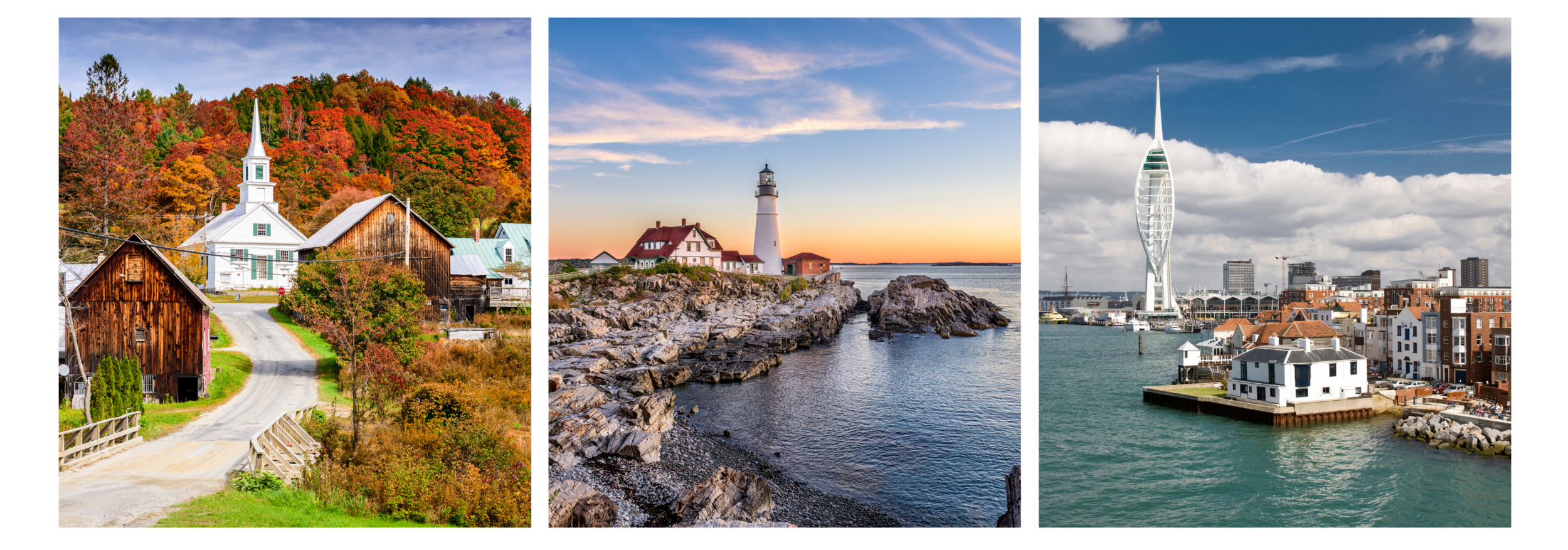
New England French is primarily native to Vermont, New Hampshire and Maine, although still endangered. After the First World War, laws were instituted to ban immersive bilingual teaching outside of dedicated foreign-language classes. In addition to this, during the 60s and 70s, some public schools disciplined students for speaking French in school. Thankfully, it is now supported and French is in many educational facilities and homes in New England today.
Even after many Acadians were exiled during the deportation of 1755, there remained a large presence of French in New England. Even when the British had control over Boston, the French language survived in the colonial city. The British would receive much of the region following the French and Indian War and the 1763 Treaty of Paris and so many of the Vermont French would return to Canada, hurting the French speaking populace even further. Since the schools in this region were also rejecting the French language, New England French fell into a decline.
It was not until the great migration of the 1840s that an immense amount of French Canadians migrated down to New England. By 1899 there were about 120 French language parishes in New England, and out of the approximate one million people of French speakers of Canada, about 600,000 had migrated primarily to New England.
New England French sounds really similar to Acadian French and Quebec French, doesn’t it? They are so close regionally and linguistically, it’s a little hard to tell the differences. Although thankfully one of the earliest examples of New England French being differentiated from Québécois and Acadian French came via a Johns Hopkins University study in 1898, detailing variants of phonology and vocabulary. These studies further expanded into the twentieth century during a revitalization of the dialect.
English Standard French New England French
· corn maïs blé d'Inde
· car voiture char
· potato pomme de terre pétate
· heavy lourd pesant
· dollar dollar piastre

Louisiana French
Also known as Cajun French, Louisiana French is an umbrella term for the plethora of dialects born out of southern Louisiana. Today, Louisiana has one of the highest densities of French speakers in the U.S. with 150,000 to 200,000 Louisiana French speakers. In fact, there would be more, but a sudden turn of events in the twentieth century bore laws and customs which encouraged the oppression of the language to make the region far more anglophone. Alas, the language survived and continues to do so. But how did it get there in the first place?
Many waves of French Canadians poured into modern day Louisiana, most notably the Acadians, who were exiled during the deportation of 1755 executed by British troops. The French populace quickly realized that the Mississippi delta would be an excellent choice in establishing an immense port city. Soon, the city would be decorated with French-named streets and quarters, walked upon by those working in everything from the shipping of agriculture products, minerals, timber and fur in the now booming industry. With this industry at the head of the region, the French were tight knit in southern Louisiana and the language continued to thrive all the way into the twenty first century.
Although the Acadian Quebec populace migrated to Louisiana, the two dialects of French remained as close cousins. However, over hundreds of years, Louisiana French has been incorporating English, African, Native American and Spanish linguistic features. Despite this, this dialect of French is fairly mutually intelligible with other dialects of French in America such as Missouri French, New England French, and of course Québécois French. So what does it look like? Let’s take a look:
Louisiana French Standard French English
· un char une voiture car
· une pelote un ballon ball
· un cabri une chèvre goat
· du train du bruit noise
· drette-là maintenant now

Missouri French
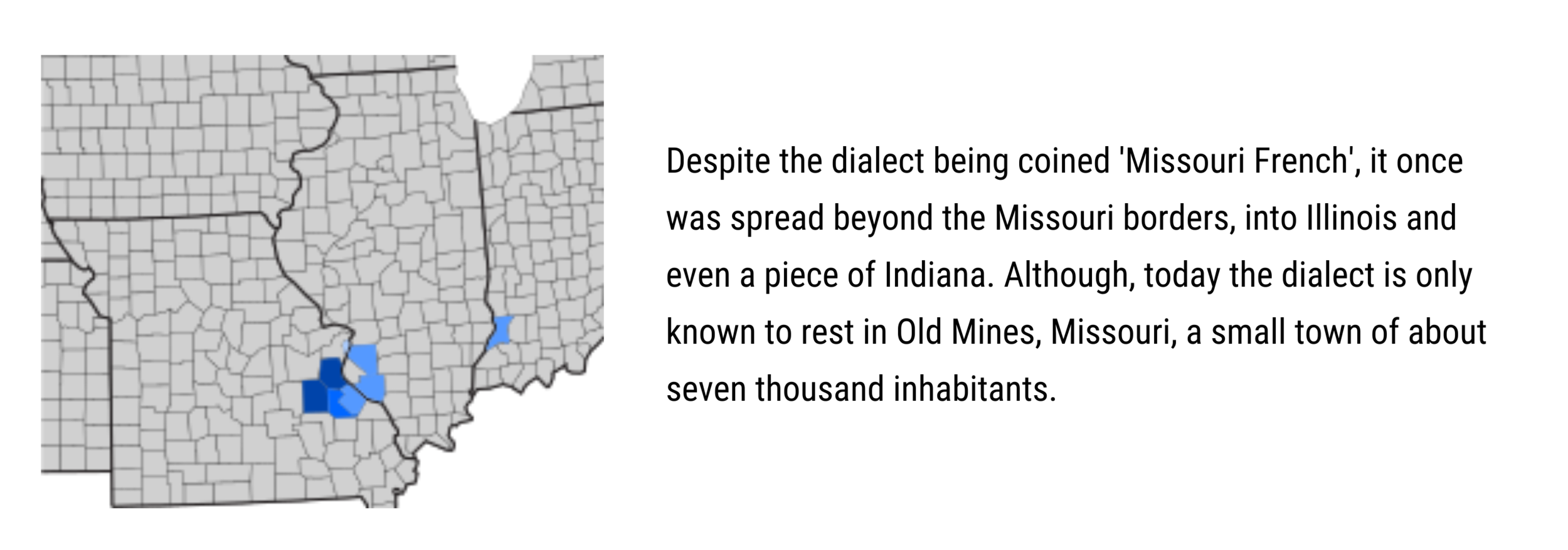
Missouri French. Otherwise known as “Paw Paw French”, this dialect is debatably the most endangered French dialects in the world. With dramatic influence from English and Native American languages and only approximately 30 people still able to speak it today, it’s worth considering to pick up! But how did this once flourished language break down into a barely documented dialect of under 100 speakers?
During the era of New France, Canadian settlers moved in and started to farm and mine for lead on the west side of the Mississippi River. Soon, the establishment of Fort de Chartres erupted and so grew a diverse population of French and Native Americans form Illinois within this newly created town. Continued immigration soon after would later birth Ste. Genevieve and St. Louis. To keep the population growing even more so, Louisiana was ceded to Spain in the Treaty of Fontainebleau and hundreds of French refugees from the Midwest had resettled into Ste. Genevieve. Finally, the Louisiana purchase became the ultimate turning point for these French settlers and the relationship between the Ste. Genevieve French and the St. Louis French became a close one. Assimilating more rapidly into the American society while new and massive mining communities erupted, these French settlers remained isolated from all other groups outside of themselves and the Natives, creating a system where they were able to heavily maintain their French heritage.
Eventually, American companies were able to purchase surrounding land, creating both a Francophone and Anglophone region. However in effect, by the early 1800s, the production of lead had rapidly declined in the area of modern day Old Mines, Missouri and after the Civil War, new mining technologies left the community completely without a means of economic survival. The decline Paw Paw French in Illinois did not occur at the same rates as it unfortunately and inevitably would in other regions. Many credit the survival of the language in Old Mines, since it has a much more isolated status in comparison to other communities such as Ste. Genevieve or St. Louis. It has also become not nearly as built up compared to these city counterparts.
To further cripple the language, the 1860s bore a German immigration and spread of their language against the French language and beginning in the 1930s, there was intense harassment and oppression towards the French speaking population by English speakers. This was due to the association of the French being uneducated, in poverty and ‘backwards’ after new, English speaking mineral companies brought in advanced excavation technologies and equipment, pushing the French populace into poverty.
Although, many individuals and groups have thankfully since tried to revitalize the language in attempt to preserve it, even today. Let’s look at a few Missouri French words and how they compare to their standard French parent and English!
Missouri French French English
· beaujour bonjour hello
· char voiture car
· zouéseau à mooches colibri hummingbird
· piastre dollar dollar
· bétail insect insect
· rabiole navet turnip
· estourneau merle blackbird
A text example of Missouri French:
"C'est bon d'vous dzire eune fouès c'étaient ein vieux rouè pis eune vieille reine. 'L ontvaient eune fille qu'était mariée et qui I'avait ein mouèyen p'tsit garçon. Pis dans c'te ville-là, 'I avait ein homme qui s'app'lait Som'pson. l' restait dans I'bois, lui. I'avait pas d'dzifférence quoi 'rouè faisait, i' l'détruisait, lui, i' l'démanchait. L'rouè avait fait perdre ein tas des hommes pour essayer d'faire détruire Sam'son. II a offert eune bonne somme d'argent pour n'importe qui y'aurait donné ein avis pour attraper Sam'son."
Want to get in touch with your French roots?
Or just want to pick up some French in spirit of the heritage month?
Schedule a consultation (for FREE!) with director Christina Ball to be matched with the perfect French instructor! We can’t wait to have you learn with us!
Meet two of our fantastique French instructors!